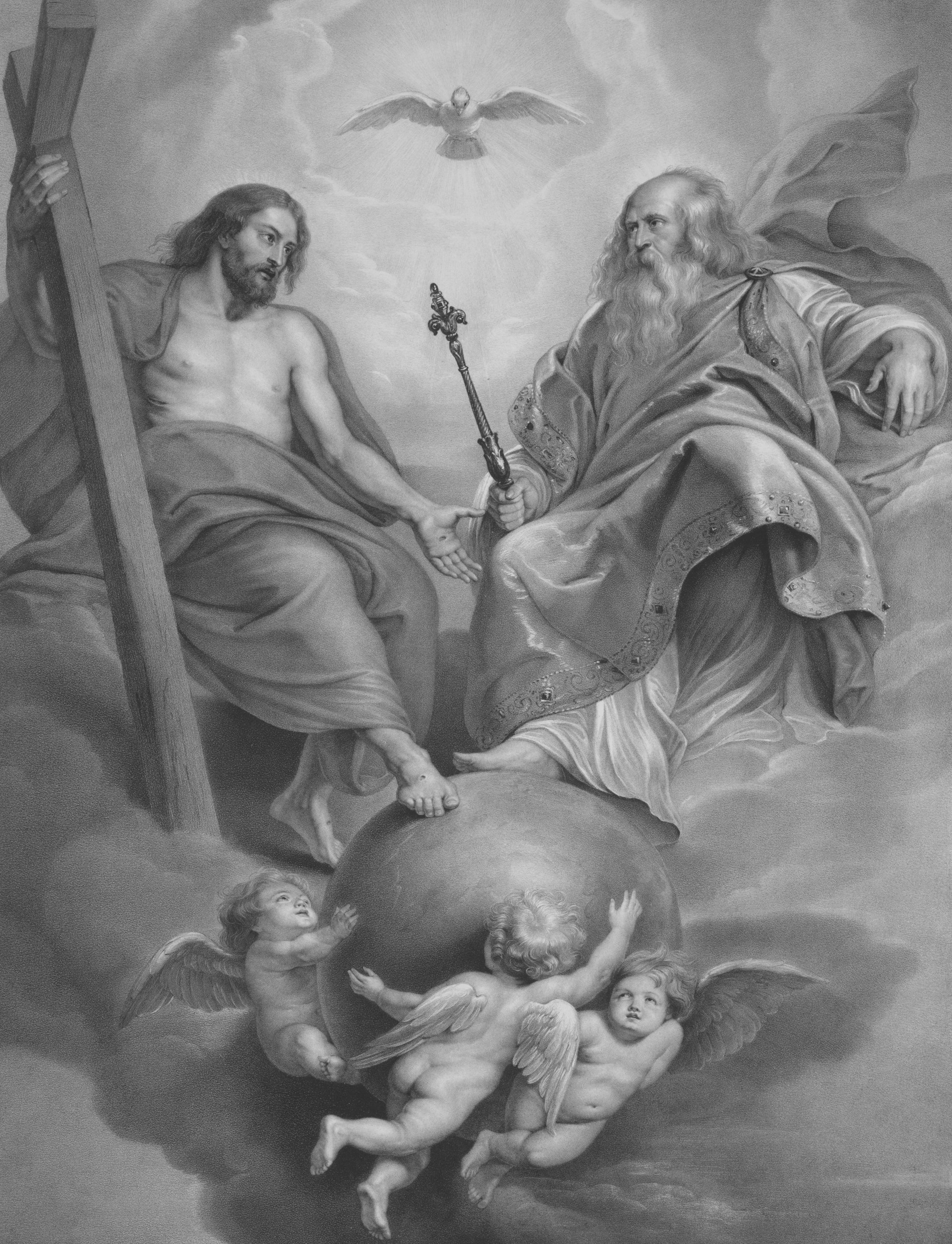
Everybody knows that the God of heaven and earth is a trinity composed of three parts: The Father, The Son, and The Holy Spirit, or do we? This dogma is enforced in nearly 100% of the Christian churches. It's actually kind of funny that, while they disagree on so many points, on this point they are tenaciously united. Except, the thing is, that the Bible really doesn't ever say that this is the case. Nowhere, does God, Jeshua, or any of the prophets say anything about a trinity. The word trinity doesn't show up even once in all of scripture. In fact there is only one line that even comes remotely close: John 1:1 - "In the beginning was the Word, and the Word was with God, and the Word was God." Sadly, I'm not in an open dialogue with the Big Guy upstairs, but I am pretty certain that if He existed as a trinity, He would have said it to somebody at least once. Not just given some indirect statement about it hoping you'd 'catch His drift'.
You know what the Bible DOES say, over and over and over and over again? That there is a distinction. That there is a Father separate from the Son. That the Holy Spirit is independent from either of them. In the New Testament alone, the word Father appears over 200 times as referencing God. The word 'son' appears over 100 times as specifically referencing Jeshua. Not once does the word father appear to refer to Jeshua, and not once does the word son appear to refer to God. These beings are clearly differentiated form one another every single time they appear. Even in heaven, where one might think the 'trinity' would appear as a united being, the Son appears BEFORE God, or the Son appears AT THE RIGHT HAND of God. I think it is pretty clear that the Bible does everything possible to distinguish and differentiate these two beings.
If we give an unbiased examination to that first verse in the book of John that we referenced earlier, we can easily realize that he is trying his best to explain who Jeshua really is in relation to God; with the language he has to work with (Greek). In this context the word "Word" is a proper name. In fact, the name 'The Word' appears many times throughout other ancient scripture. So it was not a new concept at the time. The Word was known to have been around since the beginning with God, as one of his first creations. This is exemplified in the verse John 3:16 - 'For God so loved the world, that he gave his only begotten Son, that whosoever believeth in him should not perish, but have everlasting life. ' Though, it is important to note that the translation of 'only begotten' (monogenē) is a stretch also created by the minds of men. The greek word monogenē would more accurately mean 'chosen son' or 'special son' – think along the lines of the son that would inherit the estate back in those days. The other important Greek word here is Theos. Theos means god; not God, but god. Get it? So, for Greeks: Zeus – theos, Athena theos, Hephestes – theos, Yahweh – theos, Jeshua – theos. They did not have any word to distinguish a supreme god from the lesser gods. So, when John says: "In the beginning was the Word, and the Word was with God, and the Word was God." He is trying to tell non-Christians that The Word (aka Jeshua) is at least as powerful as any other god you may know, and he has been around with God since the beginning.
'Ok', you say. 'You make an interesting argument, but does it really matter?' Yes, I say. Yes it does. When Jeshua prays in the garden, who does he pray to? His father. When Jeshua explains how to pray, who does he say to pray to? The Father. When Jeshua says who to give thanks to, again, it is the Father. If the messiah we claim to follow has instructed us to pray a certain way, I believe we should pray that way. I do not believe we should disregard his plain-as-day instructions because we have different thoughts on the matter. Knowing this distinction can make a huge difference in how we pray. When we pray, we should be praying to God the father. When we give thanks, we should be thanking God the father. And when we ask forgiveness, we should ask it of God the father. However, I believe that through all of this we should also hold Jeshua in our hearts; for he also loves us. He gave the ultimate sacrifice for us. He wants us to remember him also, just not above the father. Jeshua asked us to think of him each time we break bread and each time we drink wine. He also promised to be our intercessor and mediator with God. This means that each time we sin and repent, Jeshua goes to bat for us. He 'puts in a good word' for us with the Father. When we think of heaven, when we pray, we need to take all of this into account. This can help us all to communicate with our heavenly family in a more direct manner, and with better understanding in our hearts.
Perhaps this concept of the trinity was just human arrogance/ignorance in an attempt to categorize something for which there is no category. After all, for some the idea of another 'god' might feel unpleasant. For some, the thought of Jesus ranking below anyone might seem wrong. But perhaps, this wasn't a mistake. Perhaps this was an intentional act to subtly distort our image of heaven. Perhaps this was a play by the Devil to drive a wedge of jealousy between God and his chosen son. Who can really know but those two themselves? What matters most is not how or why. What matters most is that we seek the truth in all things. Especially matters of God and his glorious kingdom.